







Introduction
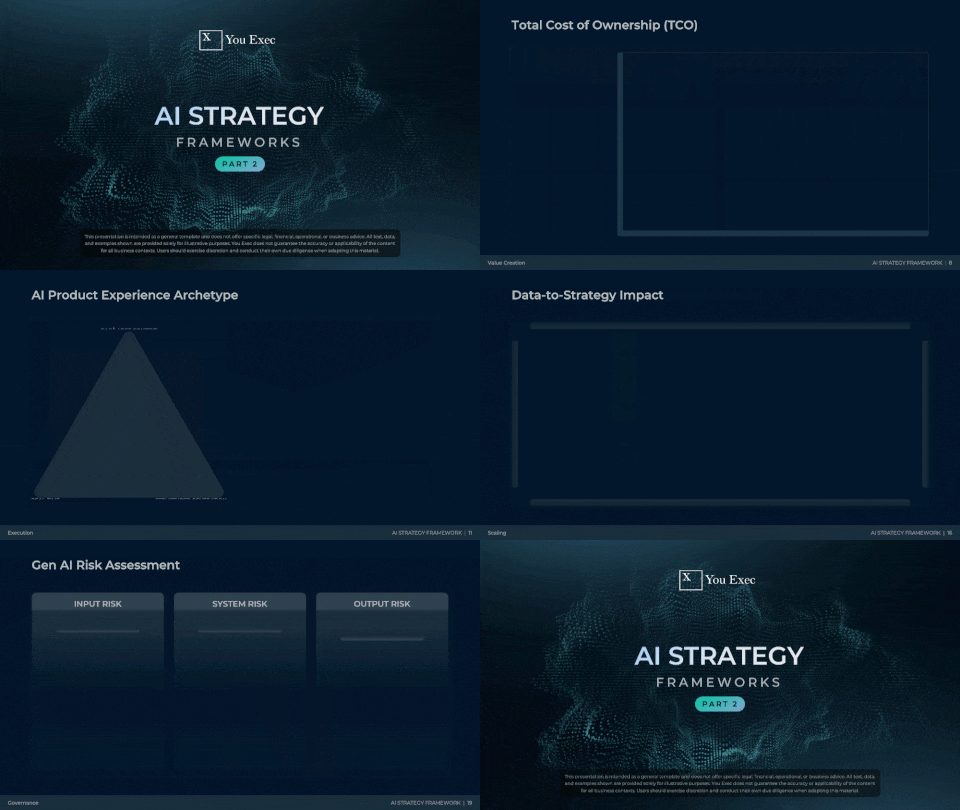
How can teams bridge strategic ambitions with the practical steps to deploy, scale, and govern AI effectively? Our AI Strategy Frameworks (Part 2) presentation provides the toolkit to turn opportunity into organized execution. It brings together strategy models that define direction, value creation approaches that pinpoint impact, execution blueprints that drive delivery, scaling frameworks that sustain adoption, and governance systems that ensure accountability. Each framework sharpens decision quality, accelerates alignment across business and technical teams, and reduces wasted experimentation.
Grounded in current industry practices, these frameworks help teams achieve faster innovation cycles, stronger collaboration, and higher returns from AI investments. Strategic consistency replaces fragmented experimentation, while governance discipline mitigates risk and builds trust. As these effects compound over time, early AI projects progress into scalable engines of performance, resilience, and long-term competitive differentiation.
Strategy
To realize true value and achieve sustained advantage with new technology, AI shouldn’t be positioned just as a capability, but as a long-term source of competitive advantage.
The Pioneer–Migrator–Settler Map frames AI strategy as a dynamic trajectory rather than a static state. It articulates whether the current portfolio emphasizes value imitation, value improvement, or value innovation, and whether that posture is intentional or accidental. As progress movements visualize over time, the map drives more honest conversations about aspiration versus reality. It also provides a shared language to discuss competitive positioning, making it easier to align investment decisions with where the organization actually wants to lead rather than where it happens to operate today.

While ambition sets direction, execution constraints often determine outcomes. The BCG’s 10–20–70 Model reframes AI challenges away from a narrow focus on algorithms and platforms. This lens is especially useful when AI initiatives stall despite strong technical foundations. By diagnosing friction in skills, incentives, governance, and prioritization, the model helps teams redirect effort toward the real bottlenecks that limit scale and impact.

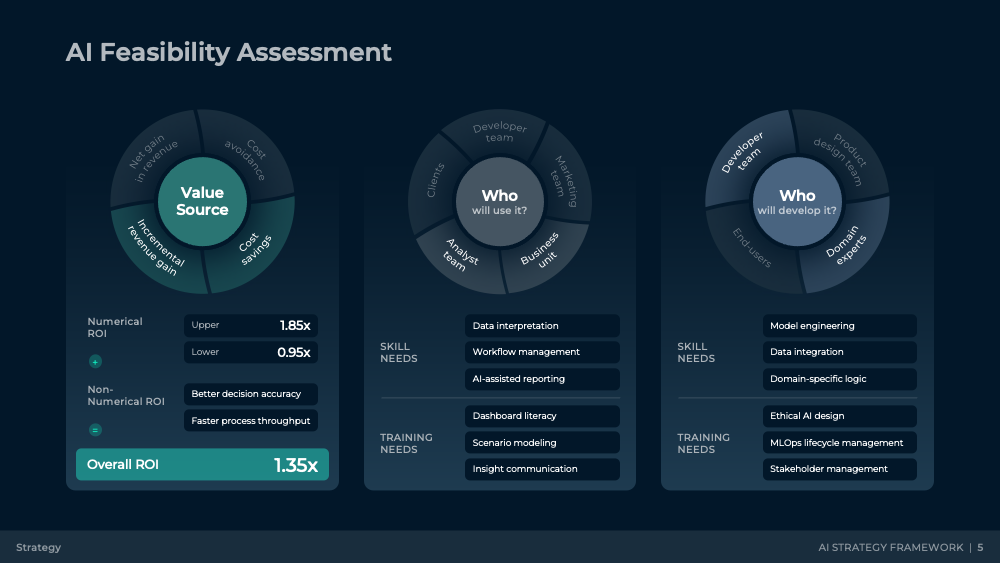
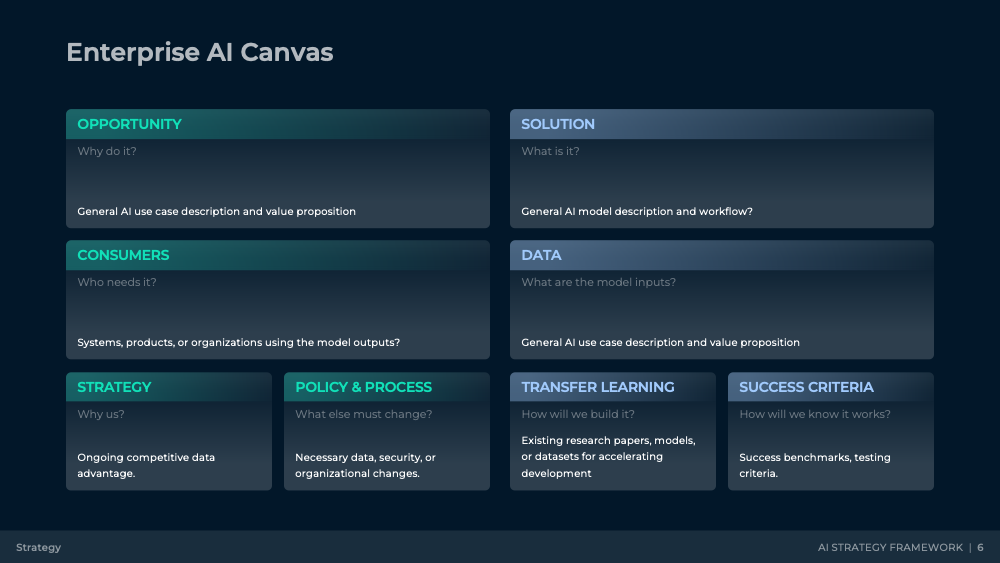
Strategic intent must also pass a reality check. The AI Feasibility Assessment evaluates where value originates, who depends on the system, and what capabilities are required to deliver results. It balances numerical ROI with non-financial gains such as decision quality and operational speed, so that feasibility discussions reflect the full value equation rather than short-term cost logic alone.
Value Creation
Value creation shifts the conversation from strategic intent to economic substance. Its purpose is to make AI value explicit, comparable, and defensible, especially in environments where enthusiasm can outpace financial discipline.
Download presentation
AI Strategy Frameworks (Part 2)
 PowerPoint
Free to join · No credit card · Already a member? Log in
Value Engineering decomposes AI value into tangible and intangible drivers and clarifies where returns actually come from and how they accumulate over time. By separating revenue growth, cost efficiency, and productivity gains from softer outcomes such as trust, ethics, and risk reduction, it avoids the common trap of overstating ROI through narrow metrics. As more AI initiatives compete for capital, this approach allows leaders to compare use cases on a consistent economic logic rather than narrative appeal.

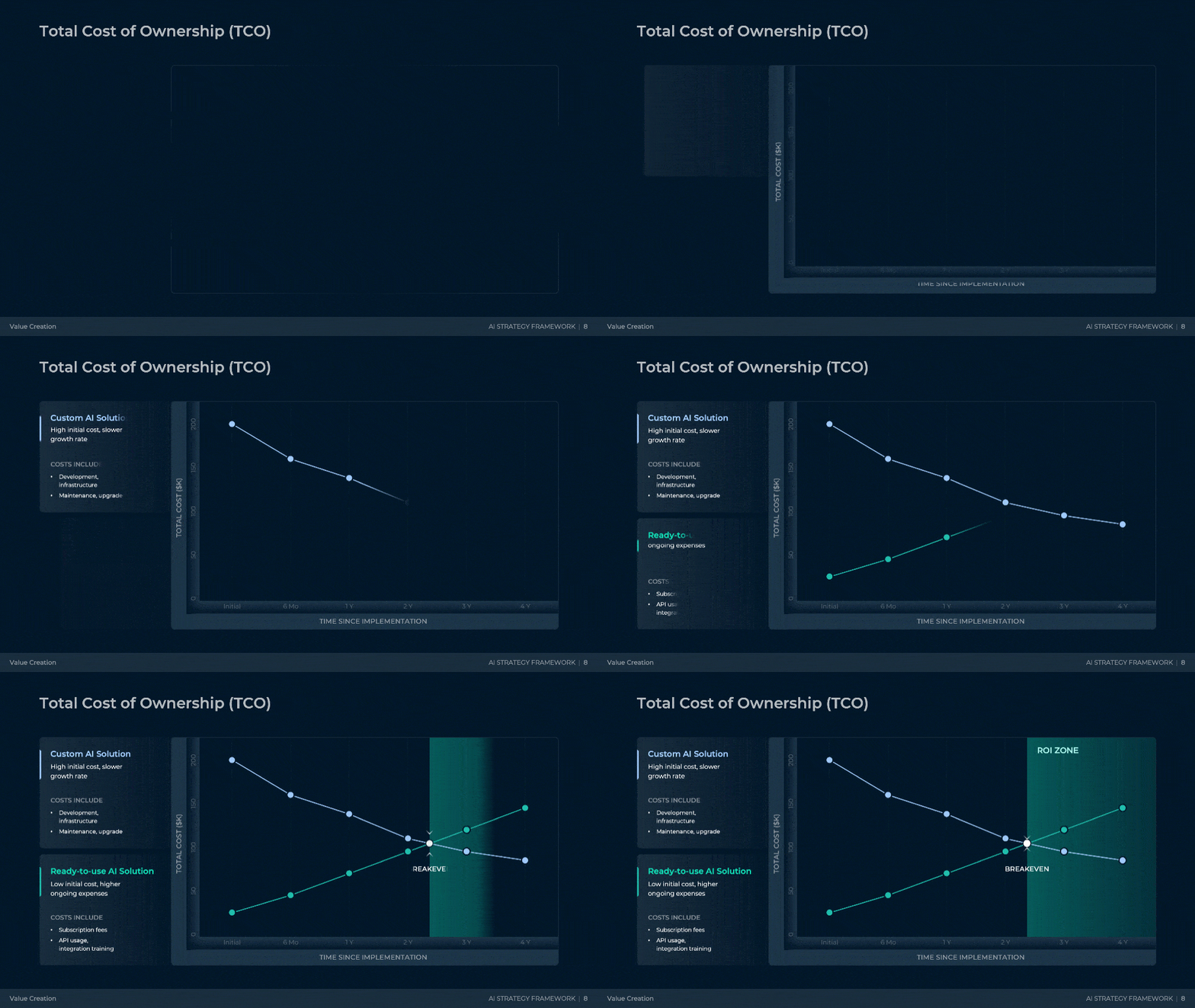
Cost discipline becomes more nuanced when scale enters the picture. Initial implementation costs, whether driven by custom development or off-the-shelf solutions, rarely tell the full story. The Total Cost of Ownership (TCO) view and the Cost vs. Value Realization curve break down how AI economics evolve across time horizons. These tools highlight how integration complexity, usage growth, infrastructure demands, and organizational change introduce second-order costs that surface well after launch. At the same time, they show that value often compounds nonlinearly once systems stabilize and adoption deepens.

Execution
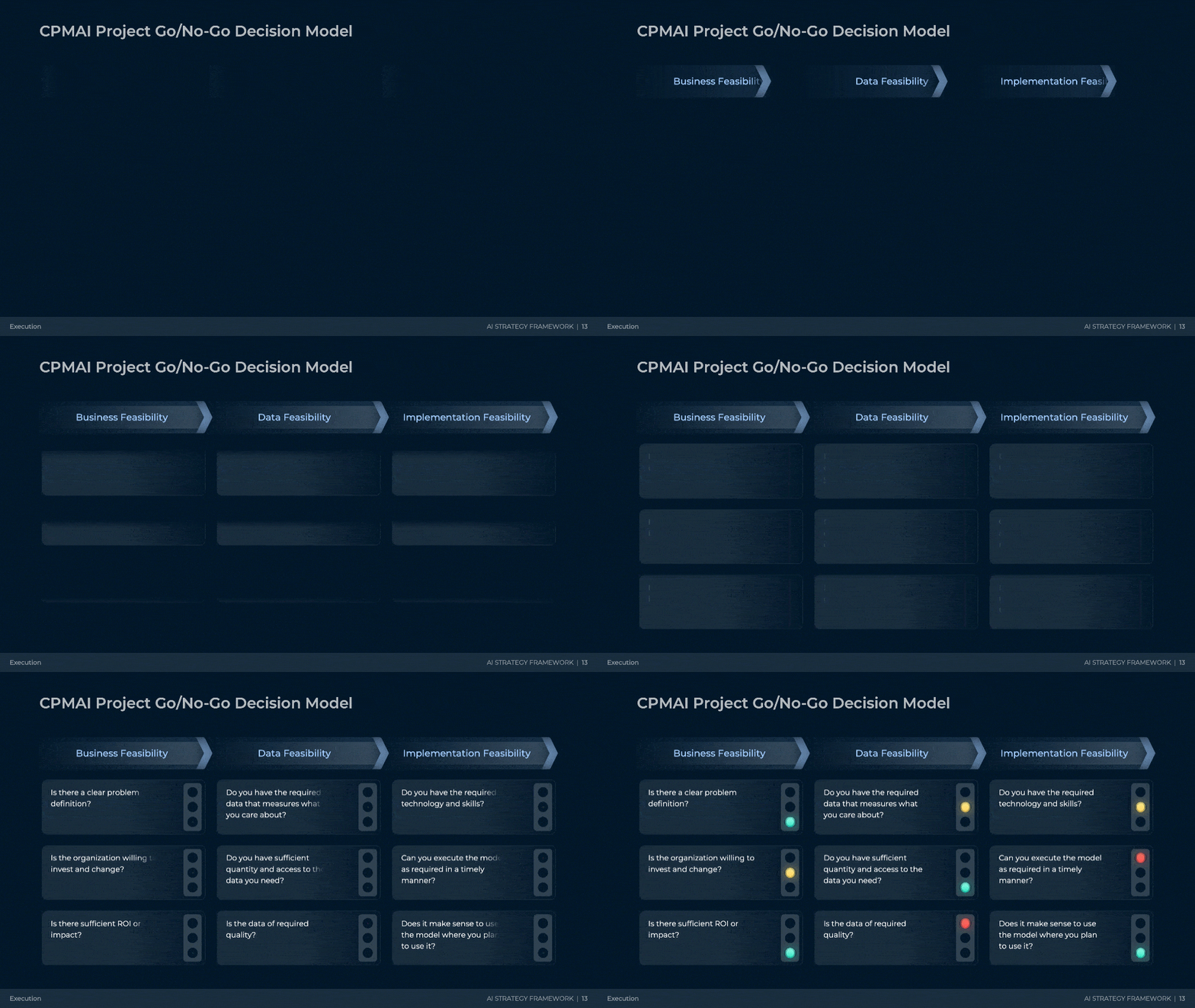
Many AI strategies falter at the point of transition from approved ideas to durable systems that operate in real environments. CPMAI’s AI Project Go/No-Go Decision Model introduces a disciplined gate before resources fully commit. By testing business, data, and implementation feasibility in parallel, the model prevents technically impressive but operationally fragile initiatives from advancing.
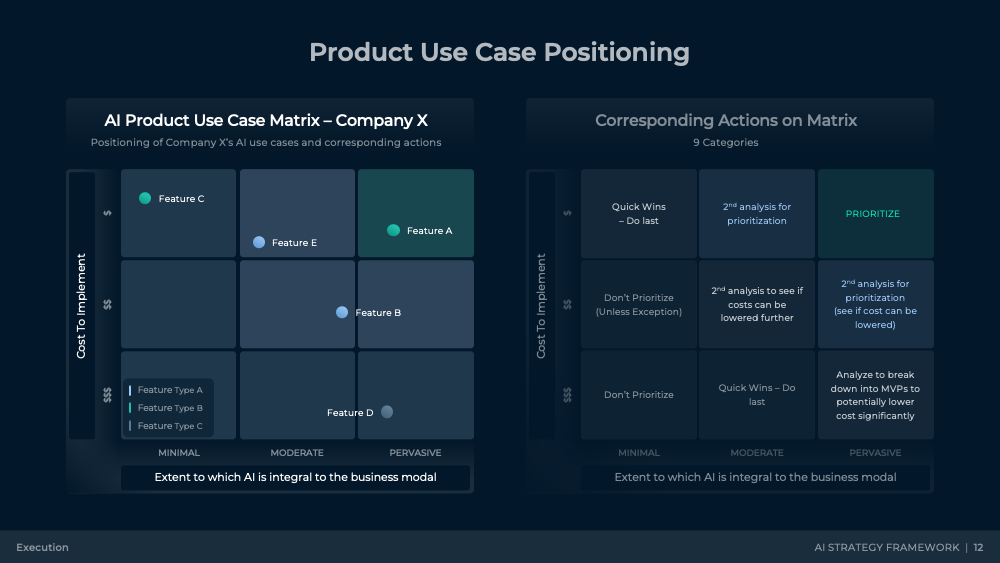
For product-centric organizations, execution clarity also depends on choosing the right AI interaction pattern. The AI Product Experience Archetype distinguishes between chat, tool, copilot, and agent-based experiences. Rather than defaulting to autonomous agents because they appear more advanced, teams can align product design with user trust, task structure, and risk tolerance.

Delivery speed and consistency hinge on how development work flows across teams. Development Lifecycle Optimization highlights how AI-enabled delivery compresses traditional stages without sacrificing validation. By collapsing discovery, experimentation, and build cycles, it reduces frictions created by siloed ownership and fragmented data.

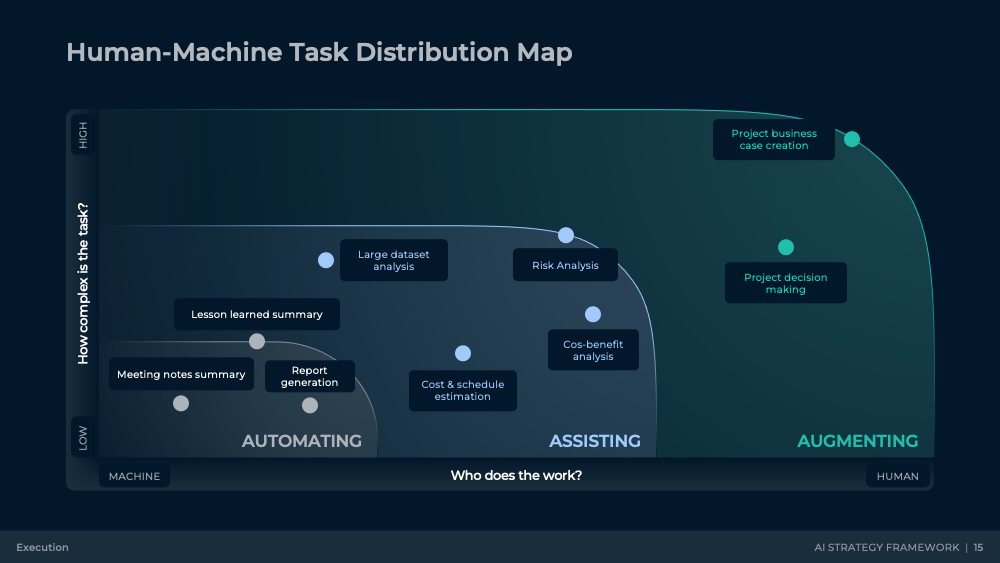
Finally, execution maturity depends on knowing where machines add leverage and where human judgment remains essential. The Human-Machine Task Distribution Map visualizes that boundary across task complexity and decision criticality. This framework prevents role confusion, builds trust in AI outputs, and supports responsible scaling.
Download presentation
AI Strategy Frameworks (Part 2)
PowerPointFree to join · No credit card · Already a member? Log in
Scaling
As AI initiatives mature, scaling becomes more about managed progression where technical ambition and organizational trust advance in parallel.
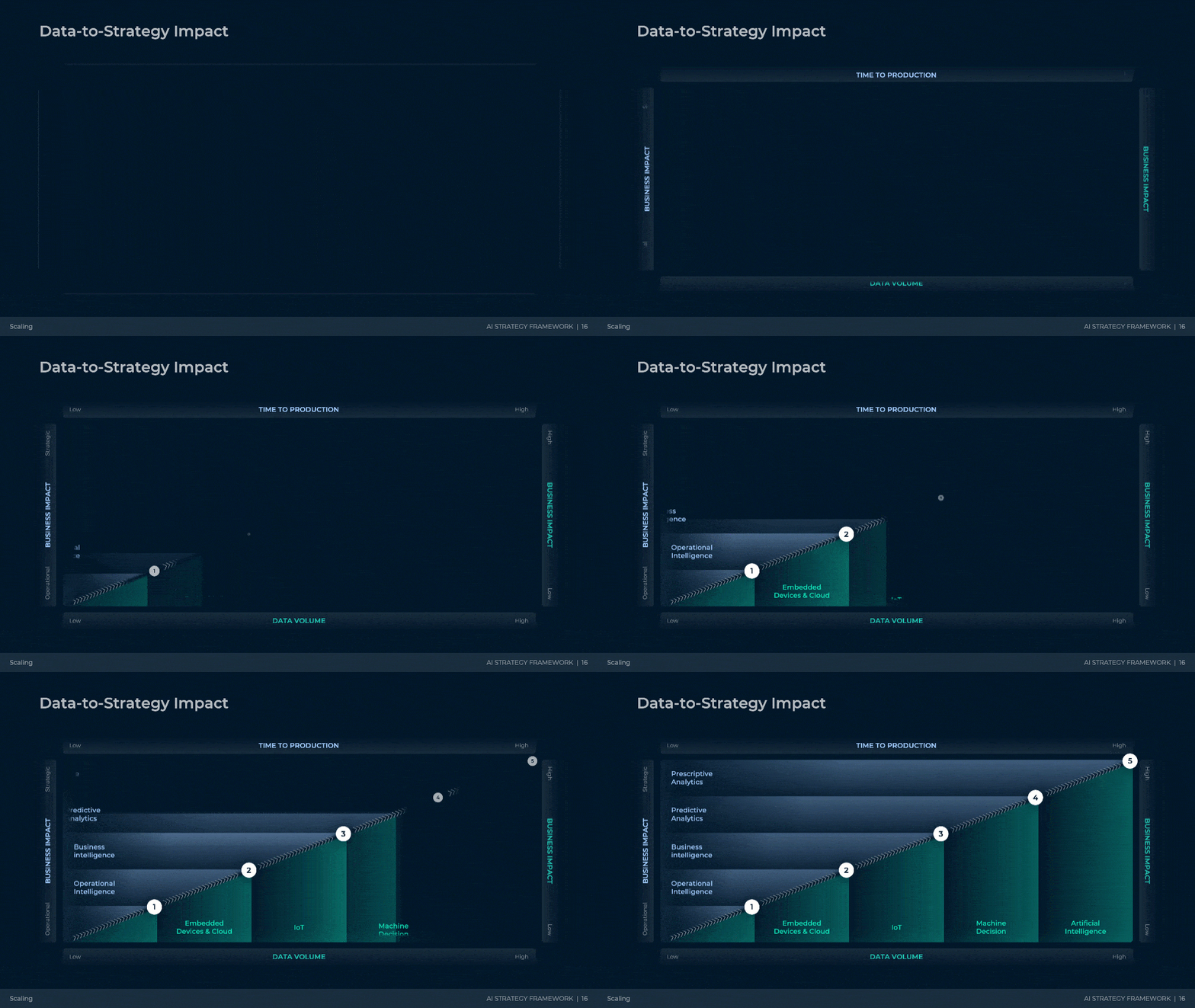
The Data-to-Strategy Impact framework clarifies how analytics capabilities evolve as AI systems absorb more data and influence higher-stakes decisions. It shows that moving from operational intelligence to predictive and prescriptive analytics is not merely a tooling upgrade, but a shift in how organizations compete. Each step along the curve demands greater rigor in data foundations, governance, and deployment maturity, while also delivering disproportionate gains in business impact.
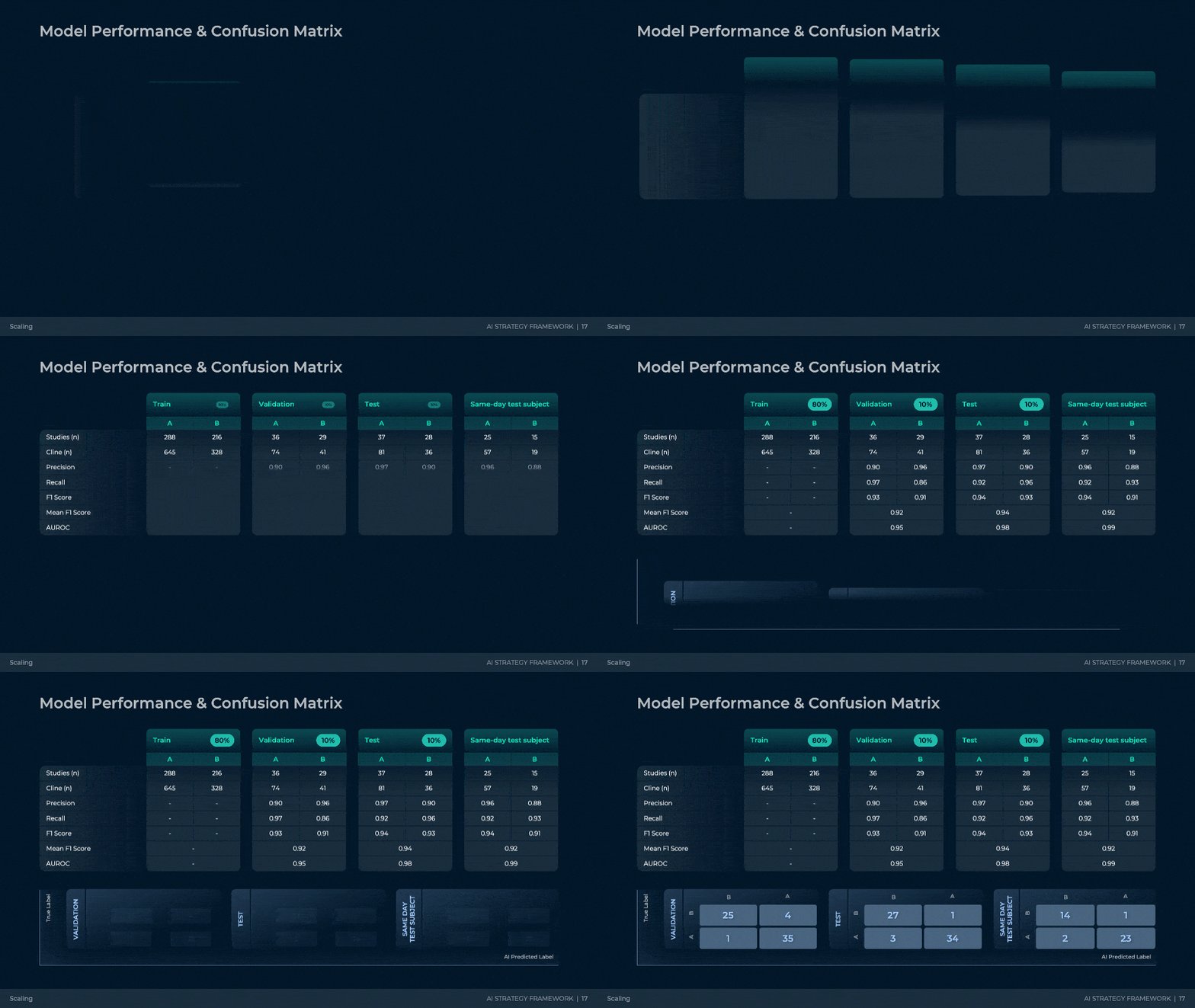
Once systems operate at scale, performance scrutiny intensifies. The Model Performance and Confusion Matrix, paired with Interpretability-Performance Trade-off, brings that scrutiny into focus. Performance metrics across training, validation, and real-world testing reveal how models behave under varied conditions, exposing stability, drift, and edge-case risk. In parallel, the interpretability curve forces explicit trade-offs between accuracy and explainability, a tension that grows sharper as models influence customer outcomes, pricing, or compliance-sensitive decisions.

Governance
AI risk is no longer hypothetical, and governance can no longer be informal. The Gen AI Risk Assessment decision tree establishes a clear way to reason about exposure before systems are deployed. Risks are categorized into input risk, system risk, and output risk, which prevents teams from collapsing all AI risk into a single judgment. This structure helps organizations distinguish between acceptable experimentation and activities that require stronger safeguards or should be avoided altogether.

Once risks are identified, the Risk Treatment Cost-Benefit model frames risk reduction as an investment choice. By comparing expected loss, probability of occurrence, and mitigation cost, leaders can justify security and compliance spending in business terms.

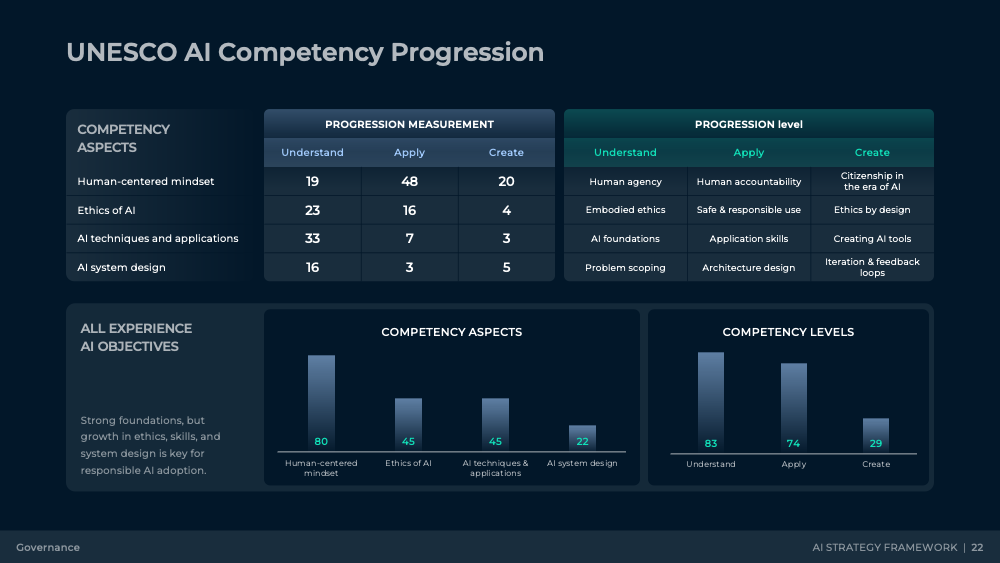
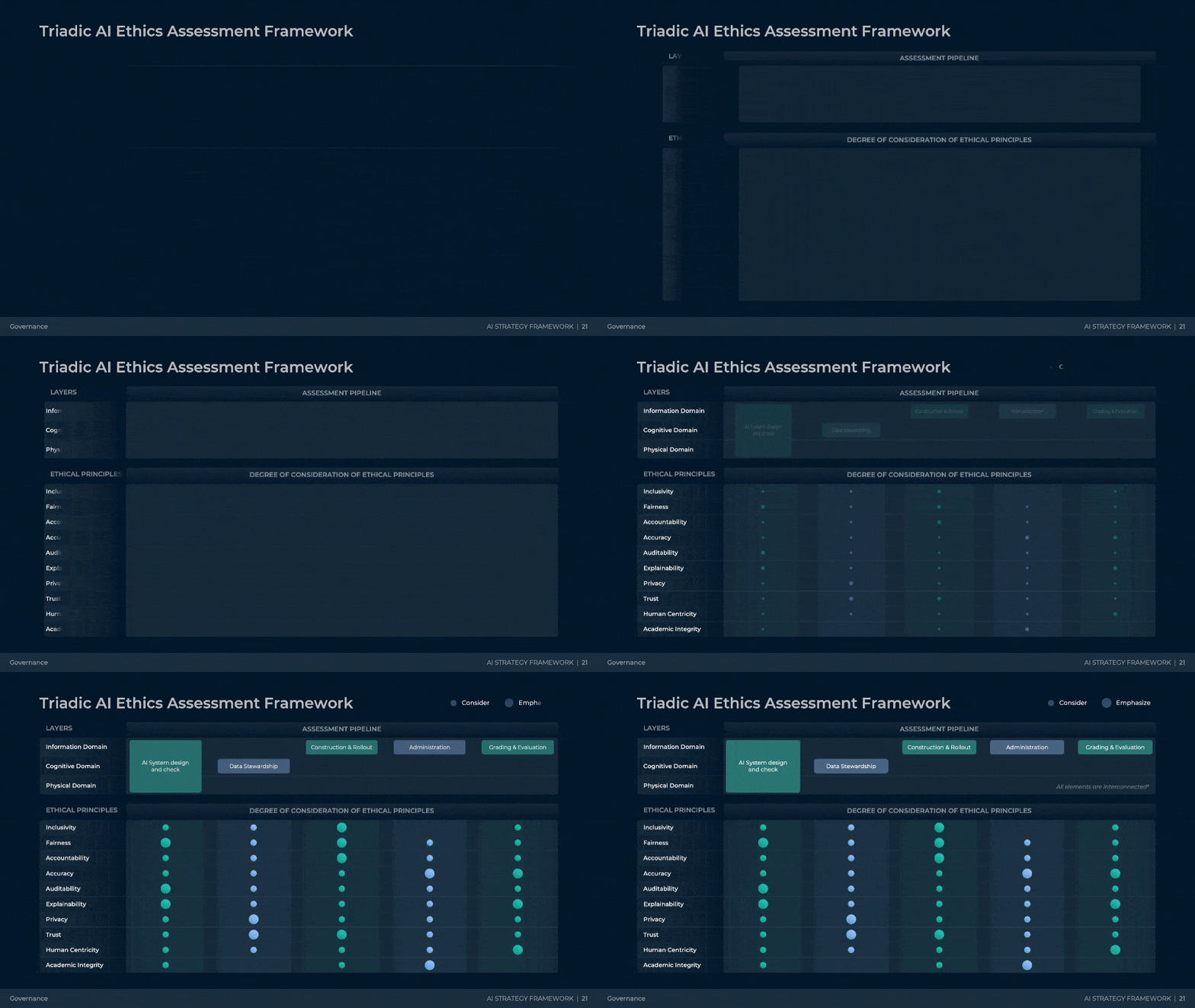
Ethical considerations require a different kind of rigor. The Triadic AI Ethics Assessment operationalizes ethics across system design, data stewardship, and deployment lifecycle. By mapping ethical principles such as fairness, accountability, explainability, and privacy across information, cognitive, and physical domains, it avoids the treatment of ethics as a one-time checklist. Instead, it reinforces that ethical performance evolves as systems scale, interact with users, and influence real-world outcomes.
Conclusion
What ultimately differentiates successful AI programs is not model sophistication, but coherence across decisions. [Name] provides the connective tissue that links ambition to economics, execution to scale, and innovation to responsibility. Apply these frameworks to move beyond isolated wins toward AI systems that compound value, earn trust, and remain durable as technologies, markets, and expectations evolve.
Download presentation
AI Strategy Frameworks (Part 2)
PowerPointFree to join · No credit card · Already a member? Log in